
How Long Does It Take to Crochet a Blanket? Time Chart by Size
How long does it take to crochet a blanket? See time charts by size and yarn weight, a 15-minute method to estimate your own finish date, and tips to finish before Christmas.

You found the perfect blanket pattern, the yarn is sitting in your cart, and Christmas is on the calendar. Then the real question hits: can I actually finish this in time? Blankets are the biggest project most of us ever crochet, and “how long will this take?” is the question that decides whether you start tonight or pick something smaller.
The good news: you don’t have to guess. Once you know your blanket size, your yarn weight and roughly how fast you stitch, you can estimate your finish date with simple math. This guide walks you through it, with time charts by size, the fastest stitches and yarns, and a realistic plan for finishing a blanket before the holidays.
Quick answer: Crocheting a blanket usually takes anywhere from about 3 hours (a small baby blanket in super bulky yarn) to 150+ hours (a queen-size blanket in worsted yarn as a beginner). A typical 50 × 60 inch throw in worsted weight (#4) yarn and half double crochet takes roughly 25–30 hours for a confident crocheter and 45–55 hours for a beginner. Chunky yarn and tall stitches can cut that time by more than half.
Key Takeaways
- Blanket size, yarn weight, stitch height and your personal speed are the four things that decide how long a crochet blanket takes.
- Count stitches, not hours: a throw blanket in worsted yarn and hdc is roughly 25,000+ stitches.
- Super bulky (#6) yarn with a 9–10 mm hook can make a throw in a single long weekend.
- Add 10–15% to any estimate for the border, weaving in ends and blocking.
- To finish by Christmas, divide your estimated hours by the days left and check you can crochet that much each day.
Table of Contents
- What Affects How Long It Takes to Crochet a Blanket?
- How Long Does It Take to Crochet a Blanket by Size?
- How Long Does It Take a Beginner to Crochet a Blanket?
- How to Estimate Your Own Blanket Time (Step by Step)
- The Fastest Way to Crochet a Blanket
- How Long Does a Granny Square Blanket Take?
- Can You Crochet a Blanket Before Christmas?
- Common Time-Wasting Mistakes
- FAQ
- Final Thoughts
What Affects How Long It Takes to Crochet a Blanket?
Two people can crochet the “same” blanket and finish weeks apart. That isn’t about talent. It comes down to four variables you can actually control or measure.
1. Blanket size
This is the biggest factor by far. A blanket’s area grows fast as it gets bigger: a queen-size blanket (about 90 × 100 inches) has roughly three times the surface of a 50 × 60 inch throw, which means roughly three times the stitches and three times the hours. If you’re unsure what size to make, our crochet blanket size and yardage chart lists the standard dimensions from baby to king.
2. Yarn weight and hook size
Thicker yarn makes bigger stitches, and bigger stitches cover more fabric per stitch. Moving from worsted (#4) yarn with a 5 mm hook to super bulky (#6) yarn with a 10 mm hook can cut the stitch count of a blanket by around 70–75%. Each stitch takes a little longer to make with chunky yarn, but you need far fewer of them.
3. Stitch height and texture
Tall stitches build fabric faster. A row of double crochet (dc) is about twice as tall as a row of single crochet (sc), so the same blanket needs roughly half as many rows. Textured stitches such as bobbles, puffs, cables or the moss stitch look gorgeous but add extra yarn-overs and slow you down. Our comparison of crochet stitches for your first blanket shows how texture, drape and effort trade off.
4. Your speed and focus
Speed improves a lot with practice. A beginner who is still counting every stitch might work at half the pace of someone who crochets most evenings. Distractions matter too: a simple repeat you can work while watching a movie goes much faster than a chart that needs your full attention.
How Long Does It Take to Crochet a Blanket by Size?
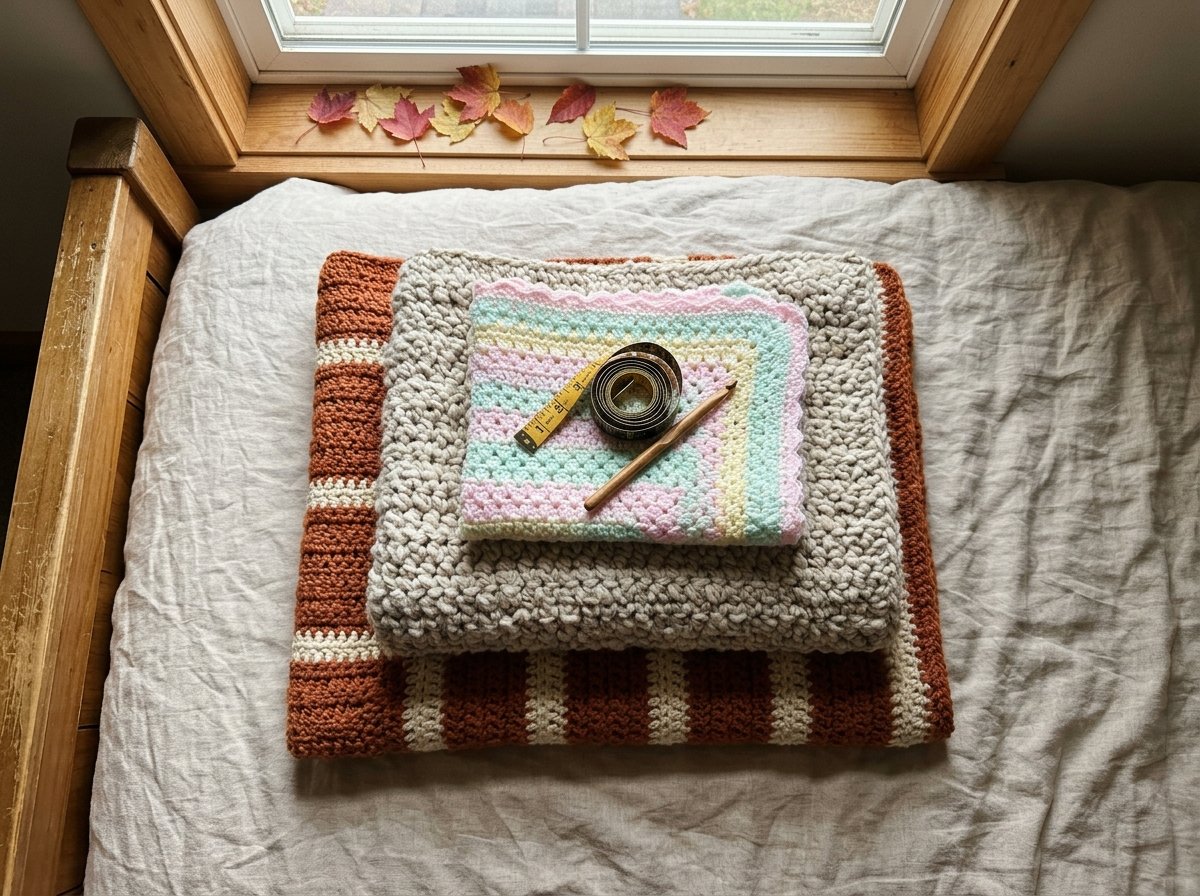
The chart below estimates the time for common blanket sizes. It’s based on stitch counts, not stopwatch averages, so treat the hours as a planning range rather than a promise. Assumptions:
- Worsted (#4): half double crochet at about 14 stitches × 10 rows per 4 inches (10 cm) with a 5–5.5 mm hook, roughly 8.75 stitches per square inch.
- Super bulky (#6): half double crochet at about 7 stitches × 5 rows per 4 inches with a 9–10 mm hook, roughly 2.2 stitches per square inch.
- Speed: about 1,000 stitches per hour for a confident crocheter and about 500 per hour for a beginner.
| Blanket | Typical size | Worsted (#4), confident | Worsted (#4), beginner | Super bulky (#6), confident |
|---|---|---|---|---|
| Baby blanket | 30 × 36 in (76 × 91 cm) | 9–11 hours | 18–22 hours | 2.5–3.5 hours |
| Lapghan | 36 × 48 in (91 × 122 cm) | 15–17 hours | 30–35 hours | 4–5 hours |
| Throw | 50 × 60 in (127 × 152 cm) | 25–30 hours | 45–55 hours | 6.5–8 hours |
| Twin | 66 × 90 in (168 × 229 cm) | 50–58 hours | 100–115 hours | 13–15 hours |
| Queen | 90 × 100 in (229 × 254 cm) | 75–85 hours | 150–170 hours | 20–24 hours |
Using double crochet instead of half double crochet shaves off roughly 25–35% because each row is taller. Using single crochet adds roughly 40–50%. The numbers include a small allowance for the border and finishing, but if your pattern has a wide decorative edge, add more.
How Long Does It Take a Beginner to Crochet a Blanket?
For a true beginner, a worsted-weight throw in half double crochet usually lands somewhere between 45 and 55 hours. At one hour a night, that’s about seven weeks. At two hours a night, it’s under a month.
Two things work in a beginner’s favor. First, your speed climbs as you go: the last third of a blanket is often noticeably faster than the first third, because your tension and hand movements settle into a rhythm. Second, a blanket is the perfect practice project because it repeats the same stitch for thousands of stitches.
If this is your very first project, start with our step-by-step first crochet lesson and practice the half double crochet stitch on a small swatch. A baby blanket or lapghan is a smarter first goal than a queen-size bedspread. You’ll finish, gain confidence, and actually use the skills on your next, bigger blanket.
How to Estimate Your Own Blanket Time (Step by Step)
Charts are helpful, but your own numbers are better. Here’s a 15-minute test that gives you a personal estimate.
- Crochet a gauge swatch. Use the yarn, hook and stitch from your pattern. Make a square at least 6 × 6 inches (15 × 15 cm) so the middle stitches are accurate.
- Count stitches per square inch. Measure 4 inches across and 4 inches down. Multiply the stitches by the rows in that square, then divide by 16. Example: 14 stitches × 10 rows = 140, ÷ 16 = 8.75 stitches per square inch.
- Find the blanket’s area. Multiply width × length in inches. A 50 × 60 inch throw = 3,000 square inches.
- Calculate total stitches. Multiply the area by stitches per square inch. 3,000 × 8.75 = 26,250 stitches.
- Time yourself for 10 minutes. Set a timer, crochet at a normal, relaxed pace and count your stitches. Multiply by 6 to get stitches per hour. If you made 120 stitches in 10 minutes, you work about 720 stitches per hour.
- Divide and add finishing time. 26,250 ÷ 720 ≈ 36.5 hours. Add 10–15% for the border, weaving in ends and blocking, and you get about 40–42 hours.
That final number is your planning figure. Pencil it into a calendar and you’ll know right away whether the deadline is realistic.
The Fastest Way to Crochet a Blanket
If you’re short on time, these changes make the biggest difference, roughly in order of impact.
Use super bulky or jumbo yarn
Super bulky (#6) yarn with a 9–10 mm (US M/N-13 to N/P-15) hook is the single biggest time saver. A throw can take one long weekend instead of a month. Pick a smooth, soft acrylic or blend so the stitches slide easily on the hook. Very fluffy chenille yarns are cozy but harder to see and count, which can slow you down.
Choose a tall, simple stitch
Double crochet is the classic speed stitch: tall, quick and easy to memorize. Half double crochet is a good compromise if you want a denser, warmer fabric. The one-row repeat in our crochet blanket stitch tutorial is another great option: it builds fabric fast and looks textured without extra effort.
Go bigger with the hook
Going up one or two hook sizes from the yarn label makes slightly larger, more open stitches. For a blanket, drape matters more than a perfect gauge, so this is an easy way to cover more ground. Just swatch first so the fabric doesn’t become too holey.
Work in long, uninterrupted sessions
Every time you stop, you lose a minute or two finding your place, recounting and settling your tension. Two one-hour sessions are usually more productive than eight 15-minute ones.
Weave in ends as you go
Crochet over your yarn tails when you change colors, or weave in each end the moment you cut it. On a striped blanket with dozens of ends, this can save an entire evening at the finish line.
Can you really crochet a blanket in 3 hours?
Yes, but only a small one. A baby or stroller blanket in jumbo (#7) or super bulky (#6) yarn with a 12–15 mm hook can be done in about 3 hours. A full throw in 3 hours isn’t realistic with a crochet hook; for that, people often turn to arm or hand “crochet” with jumbo chenille, which is really a different technique.
How Long Does a Granny Square Blanket Take?
A granny square blanket often takes longer than a solid blanket of the same size, even though each square feels quick. The extra time hides in three places:
- Ends. Every color change creates two ends to weave in. A 48-square blanket in three colors can easily mean 250+ ends.
- Joining. Sewing or crocheting the squares together can take several evenings on its own.
- Planning. Laying out colors and fixing the order takes time, too.
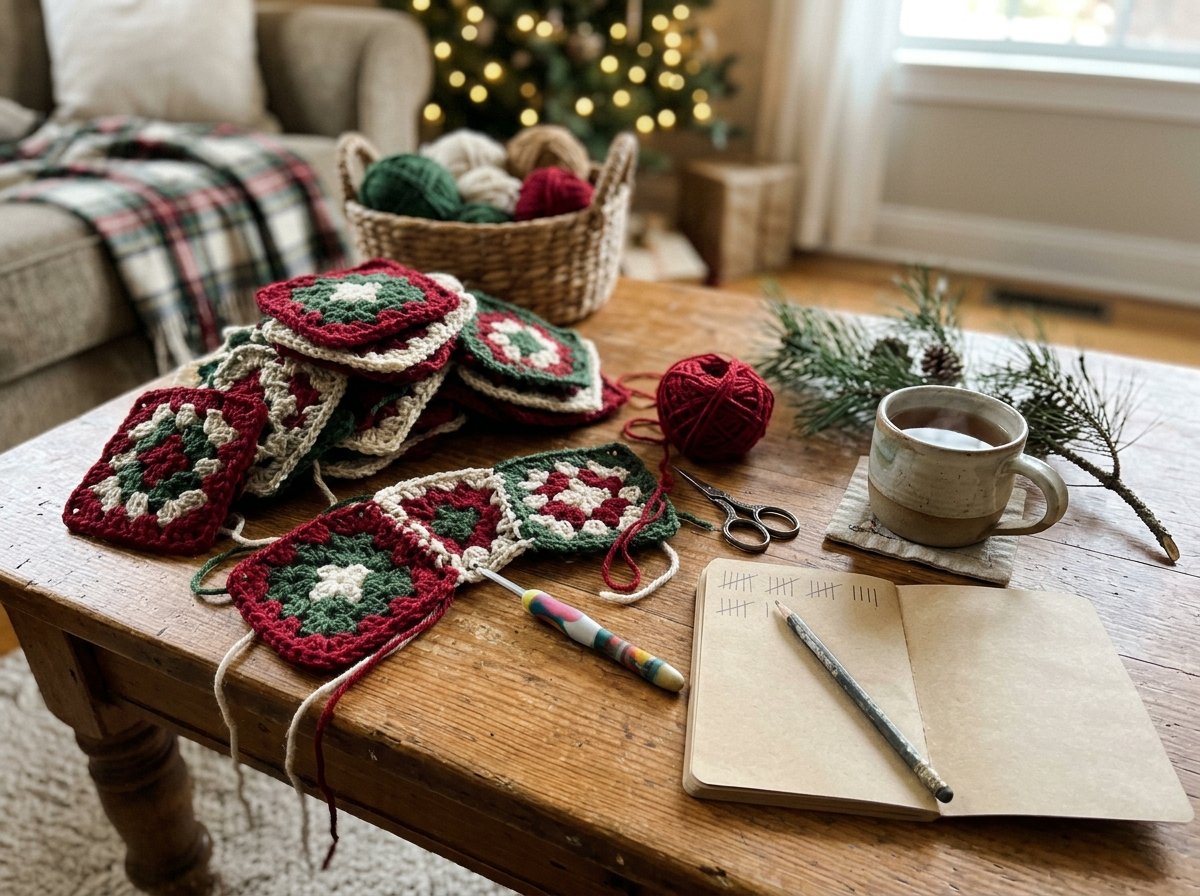
A classic 4-round square in worsted yarn takes many crocheters around 10–20 minutes. For a throw made of about 48 six-inch squares, plan roughly 10–16 hours for the squares, then several more hours for joining, ends and the border. The upside: granny squares are portable, and every finished square feels like progress. Our guide to planning and joining a granny square blanket shows how to cut down joining time with join-as-you-go methods.
Can You Crochet a Blanket Before Christmas?
Absolutely, if you pick the right size and yarn for the time you have. The trick is to work backward from the deadline. Count the days until you need to wrap the blanket (leave a few days of buffer), then divide your estimated hours by those days.
| Project | Estimated hours | Over 6 weeks | Over 4 weeks | Over 2 weeks |
|---|---|---|---|---|
| Chunky (#6) throw | about 8 | about 12 min/day | about 17 min/day | about 35 min/day |
| Worsted (#4) baby blanket | about 10 | about 15 min/day | about 20 min/day | about 45 min/day |
| Worsted (#4) throw, confident | about 30 | about 45 min/day | about 65 min/day | about 2 hrs/day |
| Worsted (#4) throw, beginner | about 50 | about 1.2 hrs/day | about 1.8 hrs/day | about 3.5 hrs/day |
If the daily number looks unrealistic, switch to a smaller size or chunkier yarn now rather than in mid-December. For a backup gift you can finish in an evening, browse our quick crochet Christmas gift ideas. And if you’d like a ready-to-follow pattern with clear photos, you’ll find printable PDF patterns in the Yarvella pattern shop.
Common Time-Wasting Mistakes (and How to Avoid Them)
- Skipping the swatch. Without a swatch you can’t estimate stitches or yardage, and you might discover halfway through that the blanket is too narrow or too stiff.
- A starting chain that’s too long or too short. Counting a 200-chain foundation twice is tedious. Place a stitch marker every 25 chains so recounting takes seconds. Or try a foundation half double crochet, which builds the chain and the first row together.
- Losing stitches at the edges. If the blanket slowly narrows or widens, you’ll end up ripping back rows. Mark the first and last stitch of each row until the pattern feels automatic. If the edges start to wave or pull in, see why crochet curls and how to fix it.
- Running out of yarn. Hunting for a matching dye lot can stall a project for weeks. Buy all your yarn at the start, plus one extra skein.
- Saving all the ends for last. Finishing a blanket and then facing 100 ends is the number-one reason blankets sit “almost done” for months.
- Picking a border that’s bigger than the blanket. An elaborate border on a big blanket can take 5–10 hours. A simple single crochet or crab stitch edge from our easy crochet blanket borders guide takes a fraction of that time.
FAQ: How Long Does It Take to Crochet a Blanket?
How many hours does it take to crochet a throw blanket?
A 50 × 60 inch throw in worsted (#4) yarn and half double crochet takes about 25–30 hours for a confident crocheter and around 45–55 hours for a beginner. In super bulky (#6) yarn, the same throw can take 6–8 hours.
Is it faster to knit or crochet a blanket?
Crochet is generally faster for a blanket because crochet stitches, especially half double and double crochet, are taller than knit stitches and build fabric more quickly. Crochet also uses a single active stitch, so it’s easy to pick up and put down.
What is the fastest crochet stitch for a blanket?
Double crochet is one of the fastest stitches for blankets because each row is tall and the motion is easy to repeat. Combine it with super bulky yarn and a 9–10 mm hook for the quickest results.
How many skeins of yarn do I need for a crochet blanket?
It depends on size and yarn weight. A worsted-weight throw often needs around 1,500–2,000 yards, while a baby blanket needs roughly 600–1,000 yards. Divide the yardage by the yards on each skein label and add one extra skein. Our blanket yardage chart breaks this down by size.
Are crochet blankets easy for beginners?
Yes. A blanket worked in one simple stitch, like half double crochet, is one of the best beginner projects. It’s repetitive and forgiving, and it needs no shaping. The only challenge is patience, which is why a baby blanket or lapghan is a great first size.
What size should a crochet blanket be?
Common sizes are 30 × 36 inches for a baby blanket, 36 × 48 inches for a lapghan, 50 × 60 inches for a throw, about 66 × 90 inches for a twin and about 90 × 100 inches for a queen. A throw is the most popular size for gifts and couches.
How long does a granny square blanket take?
A granny square throw usually takes 10–16 hours for the squares alone, plus several hours to join them, weave in ends and add a border. Join-as-you-go methods and working over your ends can save a lot of finishing time.
Final Thoughts
How long it takes to crochet a blanket isn’t a mystery. It’s a stitch count divided by your speed. Make a swatch, time yourself for 10 minutes, and you’ll have a finish date you can trust. If the deadline is tight, go smaller, go chunkier or choose a taller stitch. Whatever you pick, every row brings you closer to wrapping yourself, or someone you love, in something you made by hand.
Ready to start? Grab your hook, put on a cozy movie and crochet that first row tonight.
Keep making
How to Block Crochet: Wet, Spray & Steam Blocking for Any Yarn
Learn how to block crochet the right way for wool, cotton and acrylic: step-by-step wet, spray and steam blocking, tools, drying times and…
Read the guide
Knitting vs Crochet: Which Is Easier, Faster and Better for You?
Knitting vs crochet compared: which is easier to learn, faster, uses less yarn, and suits blankets, sweaters and gifts, plus a 20-minute crochet…
Read the guide