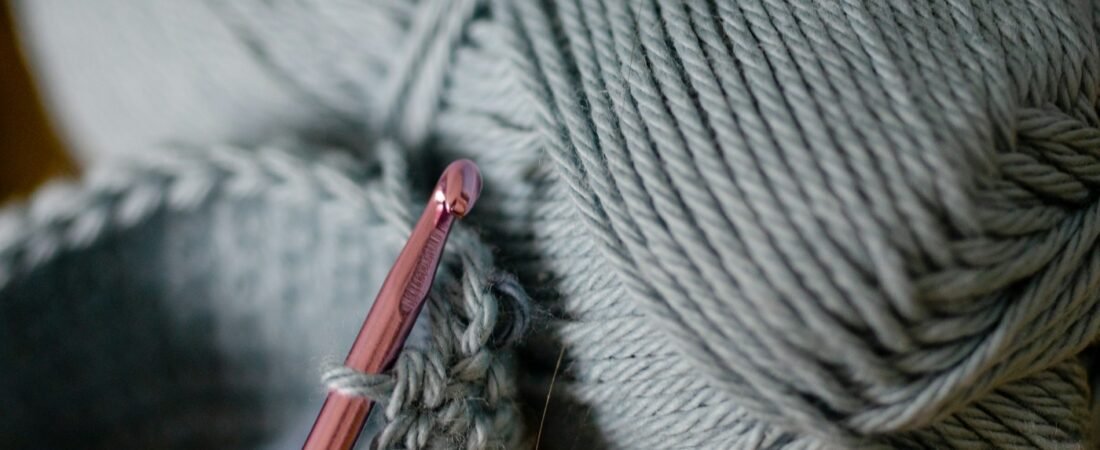
Illustrative crochet photograph by Alex Preusser via Unsplash. This is not a photograph of a Yarvella-tested sample.
Single crochet makes a compact fabric with a simple repeating movement. It is a useful starting point for dishcloths, small pouches and sturdy home projects. This guide uses US terminology; US single crochet is called double crochet in UK terminology.
What you need
Choose smooth yarn, a hook suited to the label recommendation and two stitch markers. Light yarn makes the loops easier to see. Practise with a small swatch rather than a large project.
The single crochet movement
- Insert the hook into the stitch indicated by your pattern. On an established row, this usually means under both loops of the V at the top.
- Yarn over and pull a loop through the stitch. You now have two loops on your hook.
- Yarn over again and pull through both loops. One loop remains on the hook, and one single crochet is complete.
Keep the loops loose enough to move along the hook shaft. Pulling each stitch very tight can make the following row difficult to work.
Make a 12-stitch practice swatch
- Chain 13. The loop on your hook does not count as a chain.
- Insert your hook in the second chain from the hook and make a single crochet.
- Work a single crochet in each remaining chain. Count 12 completed stitches.
- Chain one and turn the work. In this exercise, that chain does not count as a stitch.
- Make one single crochet in the first stitch and one in every stitch across: 12 stitches again.
- Repeat the last two steps for eight more rows.
Keep the edges straight
Place a marker in the first stitch after you make it, then mark the final stitch. Move both markers on each new row. This makes the ends easy to find even when the edge folds slightly.
If the row contains 11 stitches, inspect the last stitch of the previous row. If it contains 13, look for an extra stitch worked into the turning chain. Unravel to the mistake and remake that section; forcing the next row to fit will hide the cause rather than fix it.
What does a finished row look like?
Look for a row of small V shapes along the upper edge. The fabric below should feel fairly dense. A curled foundation can come from a starting chain that is tighter than the stitches above it; try a looser chain on your next swatch.
Finish the swatch
Cut the yarn with a tail long enough to weave in. Pull the tail fully through the final loop and use a blunt needle to pass it through several stitches. Change direction once to help secure it, then trim the excess.
Ready to make something useful? Take this same movement into our cotton dishcloth guide. For a taller stitch, try half double crochet.
Terminology reference: Craft Yarn Council.