
How Much Yarn for a Crochet Blanket? Size & Yardage Chart
How much yarn for a crochet blanket? Get a blanket size chart, yardage for every yarn weight, and an easy swatch method to calculate exact skeins.
You’ve found the perfect blanket pattern, you’re standing in the yarn aisle (or staring at a full online cart), and one question stops you cold: how much yarn for a crochet blanket do you actually need? Buy too little and you may never find the same dye lot again. Buy too much and you’ve spent your gift budget on skeins that will sit in a bin until spring.
The good news: you don’t have to guess. In this guide you’ll get a crochet blanket size chart, a yardage chart for every common yarn weight, a simple swatch method that tells you exactly how much your stitches use, and a quick way to turn yards into skeins. Whether you’re planning a baby blanket for a December shower or a big cozy throw to finish before the holidays, you’ll leave with a shopping list you can trust.
What’s in this guide
- The quick answer: yarn for a throw blanket
- Crochet blanket sizes (size chart)
- How much yarn for a crochet blanket: yardage chart
- What changes how much yarn you need
- The swatch method: calculate your exact yardage
- How to convert yards into skeins and balls
- Common yarn-buying mistakes
- FAQ
The quick answer: how much yarn for a throw blanket
If you only need a ballpark number, here it is. A standard crochet throw (about 50 x 60 inches) usually takes:
- Worsted weight (4): roughly 2,000–2,500 yards
- Bulky (5): roughly 1,300–1,600 yards
- Super bulky (6): roughly 700–950 yards
- DK (3): roughly 3,000–3,500 yards
These are planning estimates for solid fabric in basic stitches like single, half double or double crochet. Your real number depends on your stitch pattern, your hook size and how tightly you crochet, which is why the rest of this guide shows you how to fine-tune it. When in doubt, buy one extra skein. It is always cheaper than starting over.
Crochet blanket sizes: what size should your blanket be?
Before you can work out yardage, you need a target size. There is no single official standard, but the measurements below are widely used by designers and are a reliable place to start. Blankets meant to drape over the side of a bed need extra width and length; throws and lap blankets just need to cover a person on the couch.
| Blanket type | Typical size (inches) | Good for |
|---|---|---|
| Lovey / security blanket | 10 x 10 to 15 x 15 | Newborn gifts, quick projects |
| Stroller / car seat | 30 x 35 | Babies on the go |
| Baby / receiving | 36 x 36 to 40 x 40 | Nursery, baby showers |
| Lapghan | 36 x 48 | Wheelchairs, reading chairs, gifts |
| Throw | 50 x 60 | Couch, sofa, most gift blankets |
| Twin | 66 x 90 | Twin bed with drape |
| Full / double | 80 x 90 | Full bed with drape |
| Queen | 90 x 100 | Queen bed with drape |
| King | 108 x 100 | King bed with drape |
How long should a crochet blanket be? For a couch throw, 60 inches covers most adults from shoulders to toes. For bed blankets, measure the mattress top, then add the drop you want on each side (usually 10–15 inches). If you’re making a blanket for a specific bed, measuring beats any chart.
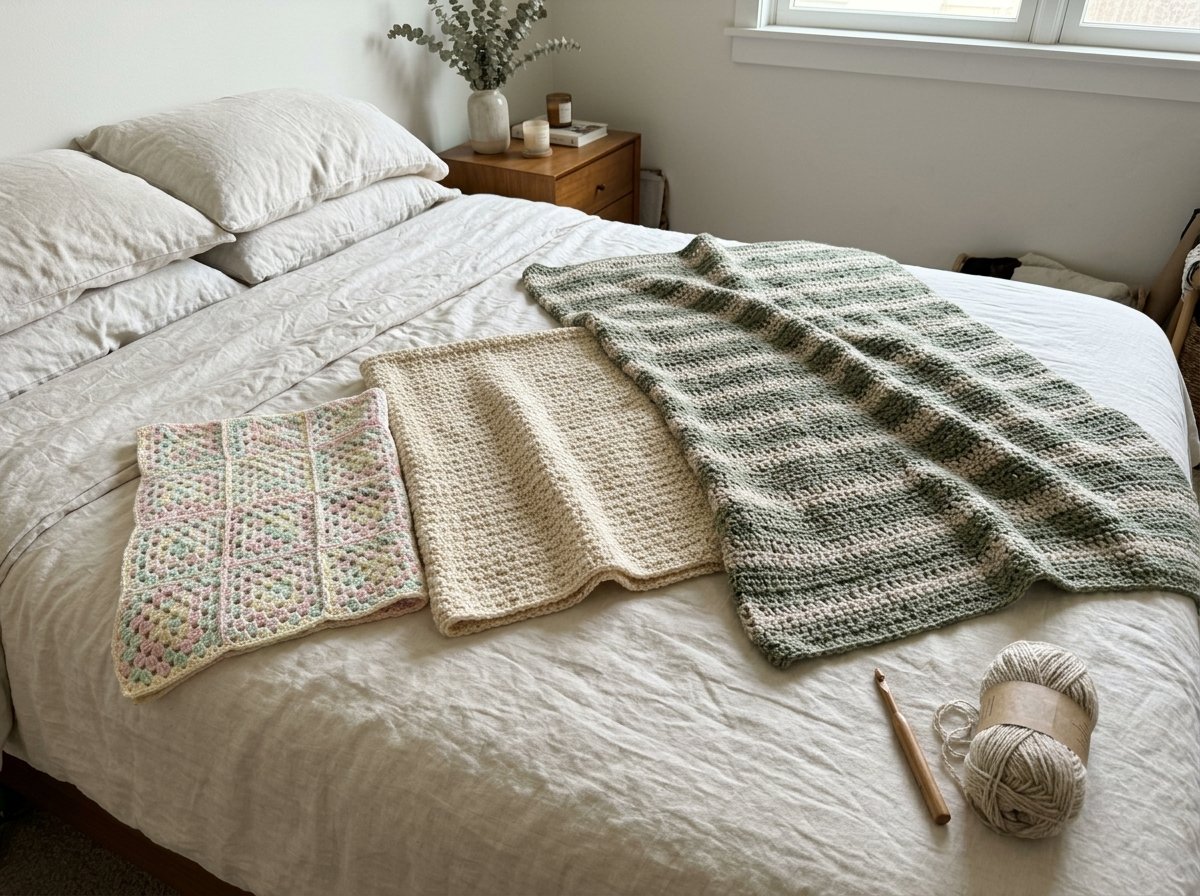
How much yarn for a crochet blanket: yardage chart by size and weight
The chart below gives estimated yardage ranges for solid crochet fabric in simple stitches. The lower number fits looser, open stitches; the higher number fits denser stitches and tighter tension. Find your blanket size, pick your yarn weight, and plan for the top of the range if you’re unsure.
| Blanket | DK (3) | Worsted (4) | Bulky (5) | Super bulky (6) |
|---|---|---|---|---|
| Stroller 30 x 35 | 1,000–1,200 yd | 700–900 yd | 450–550 yd | 250–350 yd |
| Lapghan 36 x 48 | 1,700–2,000 yd | 1,200–1,500 yd | 750–900 yd | 400–550 yd |
| Throw 50 x 60 | 3,000–3,500 yd | 2,000–2,500 yd | 1,300–1,600 yd | 700–950 yd |
| Twin 66 x 90 | 5,900–6,800 yd | 4,000–5,000 yd | 2,600–3,100 yd | 1,400–1,800 yd |
| Queen 90 x 100 | 9,000–10,500 yd | 6,000–7,500 yd | 4,000–4,800 yd | 2,200–2,800 yd |
| King 108 x 100 | 10,800–12,500 yd | 7,500–9,000 yd | 4,800–5,800 yd | 2,700–3,400 yd |
Two things jump out from this chart. First, thicker yarn needs fewer yards, but not fewer ounces: a super bulky throw often weighs about the same as a worsted one, or more, because each yard is so much heavier. Second, bed-size blankets are a big commitment. A queen blanket in worsted weight can easily run to 15–20 large skeins, so it is worth budgeting before you start.
How much yarn for a queen size blanket?
Plan on about 6,000–7,500 yards of worsted weight yarn, or 4,000–4,800 yards of bulky yarn, for a solid queen blanket around 90 x 100 inches. Textured stitches push that higher. Because queen and king blankets take so long, many crocheters make them from granny squares or panels and buy yarn in batches. If you go that route, our granny square blanket planning guide shows how to work out the number of squares you need.
How much yarn for a baby blanket?
A 30 x 35-inch stroller blanket takes about 700–900 yards of worsted weight yarn or 1,000–1,200 yards of DK. A larger 36 x 36-inch receiving blanket needs closer to 900–1,100 yards of worsted. Soft acrylic, cotton blends and baby-specific yarns in DK or worsted are the most popular choices because they wash well.
What changes how much yarn your blanket needs
Two crocheters can follow the same pattern with the same yarn and use noticeably different amounts. These are the biggest reasons why.
1. Your stitch pattern
Stitches that stack yarn on top of itself eat yardage. Puff stitch, bobbles, clusters, waffle stitch, front and back post stitches and dense textured patterns can use a lot more yarn than plain double crochet. Open and lacy patterns, like mesh, filet or shell stitches with chain spaces, use less. Tall stitches (double and treble crochet) cover area a little more efficiently than short ones (single crochet), so a single crochet blanket typically uses more yarn than the same blanket in double crochet.
Still choosing your stitch? Compare the options in our guide to crochet stitches for your first blanket, which looks at texture, drape and effort side by side. If you love a one-row repeat, the crochet blanket stitch is a great middle ground: textured, but not a yarn hog.
2. Hook size and tension
A bigger hook makes a looser, drapier fabric that uses fewer yards per square inch. A smaller hook or tight tension packs more stitches into every inch, which uses more yarn and makes a stiffer blanket. If your swatch comes out smaller than the pattern gauge, expect to need more yarn than the pattern says.
3. Yarn weight and fiber
Yarn weight decides most of your yardage, as the chart above shows. Fiber matters too. Cotton has little stretch and often makes denser fabric, while fluffy or brushed yarns can be worked a bit looser. Chenille and velvet-style yarns (very popular for chunky blankets) often come in shorter put-ups, so check yards per skein, not just the size of the ball.
4. Borders, fringe and joining
Borders are easy to forget, and they add up. A simple 2–3 round border on a throw can take a few hundred yards; wide borders, tassels or fringe take even more. Joining granny squares or panels with a slip stitch or single crochet seam also uses yarn. Set aside 10–15% of your total for edging and finishing. For border ideas that don’t ripple at the corners, see our easy crochet blanket borders.
5. Color changes
Stripes and color-blocked blankets need enough of each color, and you’ll lose a little to tails at every change. Estimate the share of the blanket each color covers, multiply by your total yardage, and round up to whole skeins per color.
The swatch method: calculate exactly how much yarn your blanket needs
Charts are a starting point, but your own swatch gives you a number built from your stitches, hook and tension. It takes about 20 minutes and it’s the most accurate method short of crocheting the whole blanket.
What you need
- The yarn and hook you’ll use for the blanket
- A kitchen scale that measures in grams (a digital food scale is perfect)
- A measuring tape or ruler
- A calculator (your phone works)
Step 1: Crochet a swatch
Make a square at least 6 x 6 inches in the exact stitch pattern of your blanket. If the pattern has a repeat, work at least one full repeat in both directions. Bigger swatches give better results. Don’t add a border.
Step 2: Measure and find the area
Lay the swatch flat without stretching it. Measure width and height and multiply them. Example: 6.5 x 6 inches = 39 square inches.
Step 3: Weigh the swatch
Weigh it in grams. Example: 15 grams.
Step 4: Work out grams per square inch
Divide the weight by the area. Example: 15 ÷ 39 = 0.385 grams per square inch.
Step 5: Multiply by the blanket area
Multiply your blanket’s width by its length, then multiply by the grams per square inch. For a 50 x 60 throw: 3,000 square inches x 0.385 = about 1,155 grams of yarn.
Step 6: Add your buffer and convert to skeins
Add 10–15% for the border, joining and weaving in ends: 1,155 x 1.15 = about 1,330 grams. Now check your yarn label. If one skein is 198 grams (7 oz), divide 1,330 by 198 = 6.7, so you’d buy 7 skeins, plus 1 extra for safety.
Prefer yards to grams? Use the label to convert. If a 198-gram skein holds 364 yards, each gram is about 1.84 yards, so 1,330 grams is roughly 2,450 yards. Another option is to crochet a swatch from a measured length of yarn (say 20 yards) and see how many square inches it covers. Divide the blanket area by that number and multiply by 20.
How to convert yards into skeins and balls
Skeins aren’t a standard unit. A “skein” can hold anything from about 80 yards (some super bulky and chenille yarns) to more than 400 yards (large worsted skeins). Always shop by yards (or meters), never by number of skeins.
- Find yards per skein on the label (often listed as both yards and meters, plus weight in ounces and grams).
- Divide your total yardage by the yards per skein.
- Round up to the next whole skein.
- Add one more skein of the main color, especially for large blankets.
How many skeins of yarn for a throw blanket?
For a 50 x 60 throw in worsted weight (2,000–2,500 yards), that’s about 6–7 large 364-yard skeins, or 10–13 smaller skeins of around 200 yards. In super bulky yarn (700–950 yards), it’s often 6–12 skeins depending on the put-up, since many super bulky skeins only hold 80–140 yards.
How many 100g balls of yarn do you need for a crochet blanket?
A worsted 100-gram ball usually holds about 180–220 yards. Using the chart above, a worsted throw needs roughly 10–13 balls, a baby blanket 4–5 balls, and a lapghan 6–8 balls. Check your specific label, since yardage per 100 grams varies by fiber.
Dye lots: the rule you shouldn’t skip
Yarn is dyed in batches, and each batch (dye lot) can be a slightly different shade. The difference is often invisible on the shelf but obvious in a finished blanket. Buy all the yarn for each color from the same dye lot (printed on the label) at the same time. If you do end up mixing lots, alternate them every two rows for a few rows to blend the change.
Common yarn-buying mistakes (and how to avoid them)
- Counting skeins instead of yards. “Eight skeins” means nothing without yardage. Two yarns of the same weight can differ by more than 100 yards per skein.
- Skipping the swatch. Tension varies a lot from person to person. A 20-minute swatch can save you a frustrating trip back to the store.
- Forgetting the border. Set aside 10–15% of your total for edging and finishing.
- Substituting yarn by weight category only. If you swap the yarn in a pattern, convert the pattern’s total yardage (not skein count) to your new yarn.
- Ignoring the dye lot. Buy enough from one lot up front, and keep one label so you can find a match later.
- Running out of a contrast color. Stripes and color blocks use more than you’d think. Calculate each color separately.
Smart tips for planning your blanket yarn
- Weigh as you go. After the first 10% of the blanket, weigh your finished piece and compare it to your estimate. You’ll know early if you need to order more.
- Keep receipts and labels. Many stores accept returns on unopened skeins, which makes the “one extra skein” rule painless.
- Use leftovers well. Extra yarn is perfect for a matching pillow, a mug cozy or small gifts. Our quick crochet gifts you can make in one evening are ideal scrap-busters.
- Brush up on pattern terms. Pattern yardage is usually listed in the materials section, often next to the gauge. If any abbreviations are unclear, keep our crochet abbreviations cheat sheet handy.
Want a pattern with the yardage already worked out for you? Every printable PDF in the Yarvella Crochet pattern store lists the yarn weight, hook size and materials you’ll need before you start.
Crochet blanket yarn FAQ
How many skeins of yarn do you need to crochet a throw blanket?
For a 50 x 60-inch throw in worsted weight, plan on about 2,000–2,500 yards, or roughly 6–7 large skeins of 364 yards each. For bulky yarn, plan on 1,300–1,600 yards. Always divide total yards by the yards on your label and buy one extra skein.
How many balls of yarn does it take to make a blanket?
It depends on the blanket size and the yards per ball. With standard 100-gram worsted balls (about 200 yards each), a baby blanket takes around 4–5 balls, a lapghan 6–8, and a throw 10–13. Bed-size blankets can need 20 or more.
What size should a crochet blanket be?
Common sizes are 30 x 35 inches for a stroller blanket, 36 x 48 inches for a lapghan, 50 x 60 inches for a throw, 66 x 90 for a twin, 90 x 100 for a queen and 108 x 100 for a king. A throw is the most popular size for gifts and couch blankets.
Does crochet use more yarn than knitting?
Generally, yes. Crochet stitches are built from several loops stacked together, so crochet fabric is usually thicker and uses more yarn than knitted fabric of the same size and yarn weight. That’s why you shouldn’t use knitting yardage to plan a crochet blanket.
How long does it take a beginner to crochet a blanket?
It varies widely with yarn weight, stitch and how often you crochet. A super bulky throw in simple stitches can be done over a weekend, while a worsted throw often takes several weeks of evening crocheting. Thicker yarn and taller stitches like double crochet are the fastest way to finish.
What is the best yarn weight for a first crochet blanket?
Bulky (5) or worsted (4) acrylic yarn is the easiest choice: stitches are easy to see, it’s affordable, and it’s machine washable. If you’re brand new, start with our beginner crochet lesson and practice your stitches on a swatch first.
What supplies do I need to crochet a blanket?
You need your yarn (with the yardage worked out above), a crochet hook in the size recommended on the label, a yarn needle for weaving in ends, scissors, a measuring tape and a few stitch markers. A kitchen scale is optional but very handy for estimating yarn.
Ready to buy your blanket yarn?
Working out how much yarn for a crochet blanket comes down to three steps: pick your size, check the yardage chart for your yarn weight, and confirm it with a quick swatch. Add 10–15% for the border, buy everything from one dye lot, and grab one extra skein. With a plan like that, the only thing left to worry about is which color to pick.
Happy hooking, and enjoy every cozy row!
Keep making

Easy Crochet Christmas Ornaments: 5 Free Beginner Patterns
Make 5 easy crochet Christmas ornaments: a candy cane, bauble, star, mini hat and holly, with free beginner patterns in US terms, tips…
Read the guide
Gifts for Crocheters: 30 Ideas They’ll Actually Use (by Budget)
The best gifts for crocheters, sorted by budget: ergonomic hooks, yarn tools, project bags, stocking stuffers and handmade ideas, plus how to buy…
Read the guide