
How to Crochet a Blanket for Beginners: Easy Step-by-Step Guide + Free Pattern
Learn how to crochet a blanket step by step: yarn, hook size, the best beginner stitch, a size chart and a free chunky half double crochet throw pattern.
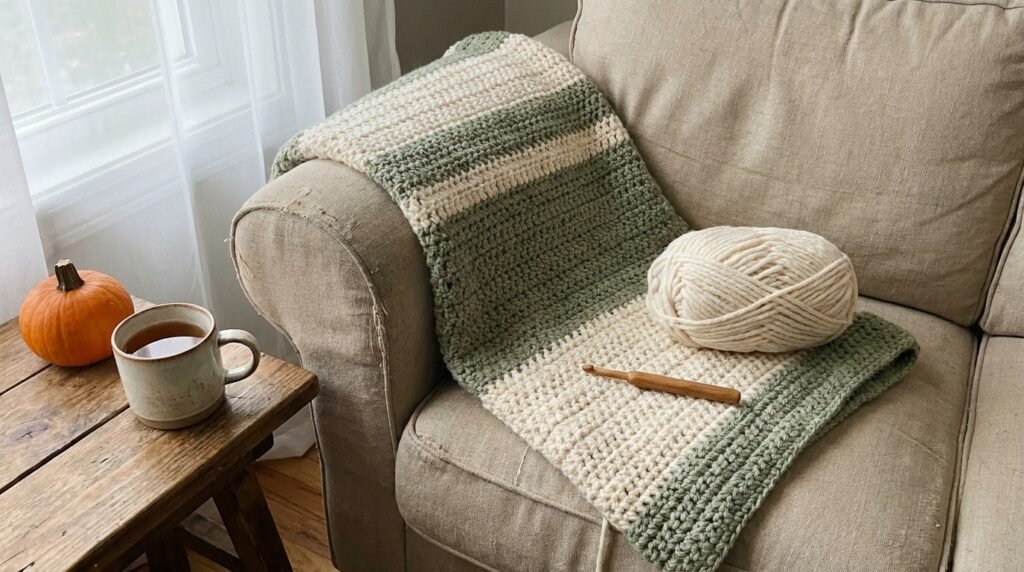
There’s a moment every new crocheter hits: you’ve made a dishcloth, maybe a scarf, and now you’re eyeing the couch thinking, “Could I actually make a whole blanket?” You can. A blanket is one of the best beginner projects out there because it’s just rows on top of rows. No shaping, no counting increases, no tiny pieces to sew together. Just you, a cozy yarn, and a pile of fabric that grows every evening.
This guide walks you through the entire process, from picking yarn to weaving in the very last end. It also includes a free, beginner-friendly pattern for a chunky half double crochet throw that you can size up or down for a baby, the couch, or a Christmas gift.
Quick answer: how do you crochet a blanket?
- Choose a bulky (#5) yarn and the hook size on its label (about 8 mm / L-11).
- Make a foundation chain as wide as you want the blanket.
- Work one easy stitch (single or half double crochet) into each chain, then turn.
- Repeat the same row, counting stitches, until the blanket is long enough.
- Add a simple single crochet border, weave in your ends, and block it.
A lap-size chunky blanket usually takes a beginner somewhere around 15 to 25 hours of hooking.
In this guide
Can a Beginner Crochet a Blanket?
Yes, and honestly it’s one of the smartest first big projects. Here’s why it works so well:
- It’s repetitive in a good way. You learn one stitch and repeat it hundreds of times. By row ten, your hands know what to do.
- Mistakes hide. A slightly loose stitch in the middle of a big, squishy throw disappears once it’s on the couch.
- You can stop anytime. Run out of patience at 36 inches? Congratulations, you made a baby blanket.
The only real challenge is stamina. A blanket takes more hours than a hat, so the trick is choosing thick yarn and a simple stitch that feels relaxing rather than fiddly. If you’ve never held a hook before, start with our first crochet lesson and practice a small swatch, then come back here.
What You Need to Crochet a Blanket
You don’t need much. Here’s the full supply list for the pattern below:
- Yarn: bulky weight (#5) acrylic or acrylic blend, around 1,100 to 1,300 yards for a lap throw (more on sizes below). Pick a smooth, light-colored yarn so you can see your stitches.
- Hook: 8 mm (US L-11). An ergonomic handle helps a lot on long projects.
- Stitch markers: at least 2, for the first and last stitch of each row.
- Tapestry needle with a large eye for weaving in ends.
- Scissors and a measuring tape.
Which yarn is best for a beginner blanket?
For a first blanket, choose a bulky (#5) acrylic. It’s affordable, machine washable, comes in endless colors, and works up fast. Avoid these for now:
- Chenille and velvet yarns: super soft but very hard to see stitches in, and they can “worm” (pop out loops).
- Dark colors: navy and black hide every stitch, which makes counting frustrating.
- Thin yarn (#3 or lighter): lovely results, but a blanket can take three or four times as long.
Worsted weight (#4) is a fine choice too, just expect more rows and more hours. Always check the label: it lists the weight number, the recommended hook size, and the yardage per skein.
What hook size do I need?
Use the hook size printed on your yarn label as the starting point. For most bulky yarns that’s 6.5 to 9 mm; for worsted it’s usually 5 to 5.5 mm (H-8 to I-9). Blankets look and feel best when the fabric is soft and drapey, so if your swatch feels stiff like cardboard, go up half a size.
The Best Stitch for a First Blanket
You can make a blanket with any basic stitch, but each one behaves differently:
- Single crochet (sc): the easiest, but very dense. It uses lots of yarn and takes the longest.
- Half double crochet (hdc): the sweet spot. Taller than sc, so it grows faster, but still solid and warm. Very forgiving with tension.
- Double crochet (dc): the fastest, but the fabric has gaps and tends to be floppy and less warm.
That’s why the pattern below uses half double crochet. If you’d like to compare textures before you commit, our guide to crochet stitches for your first blanket shows how sc, hdc, moss stitch and more look side by side.
What Size Should a Crochet Blanket Be?
There’s no single “correct” size. It depends on who it’s for and where it’ll live. These are common finished sizes, with approximate stitch and row counts for the pattern below (bulky yarn, hdc, gauge of about 9 stitches and 7 rows per 4 inches):
| Blanket | Finished size | Chain | Rows (approx.) | Yarn (approx.) |
|---|---|---|---|---|
| Baby / stroller | 30 × 36 in | 70 | 63 | 600–750 yd |
| Lap throw | 40 × 50 in | 92 | 88 | 1,100–1,300 yd |
| Couch throw | 50 × 60 in | 114 | 105 | 1,600–1,900 yd |
Yardage varies a lot with your tension and the exact yarn, so treat these as planning numbers and buy an extra skein from the same dye lot. For larger sizes (twin, queen, king) and other yarn weights, see our full crochet blanket size and yardage chart.
Free Pattern: Cozy Weekend Chunky Throw
This is a simple, solid, reversible blanket worked in rows of half double crochet. It looks the same on both sides, so you never have to worry about a “wrong side.”
- Skill level: beginner
- Finished size: about 40 × 50 in (lap throw), before border
- Yarn: bulky (#5), approx. 1,100–1,300 yd
- Hook: 8 mm (L-11)
- Gauge: about 9 hdc and 7 rows = 4 in (gauge is flexible for a blanket, it only changes size and yardage)
- Time: roughly 15–25 hours for a beginner
- Terms: US. ch = chain, hdc = half double crochet, sc = single crochet, st(s) = stitch(es), sl st = slip stitch
New to abbreviations? Keep our crochet abbreviations cheat sheet open in another tab.
Step 1: Make a quick gauge swatch (10 minutes)
Chain 16 and work 10 rows following the pattern below. Measure the middle 4 inches. If you have more than 9 stitches, your blanket will come out narrower, so go up a hook size or add chains. If you have fewer, it will be wider. For a blanket, close is good enough; the swatch mostly helps you decide how many chains to make.
Step 2: Make the foundation chain
Ch 92. This gives you 90 hdc across, about 40 inches wide.
Foundation chains for blankets are famous for being too tight, which makes the bottom edge pull in. Two easy fixes: chain loosely, or make the chain with a hook one size bigger (9 mm), then switch back to 8 mm for Row 1. Before starting Row 1, lay the chain flat and make sure it isn’t twisted.
Want a different width? Chain any number you like, then add 2. Every 9 chains add roughly 4 inches.
Step 3: Row 1
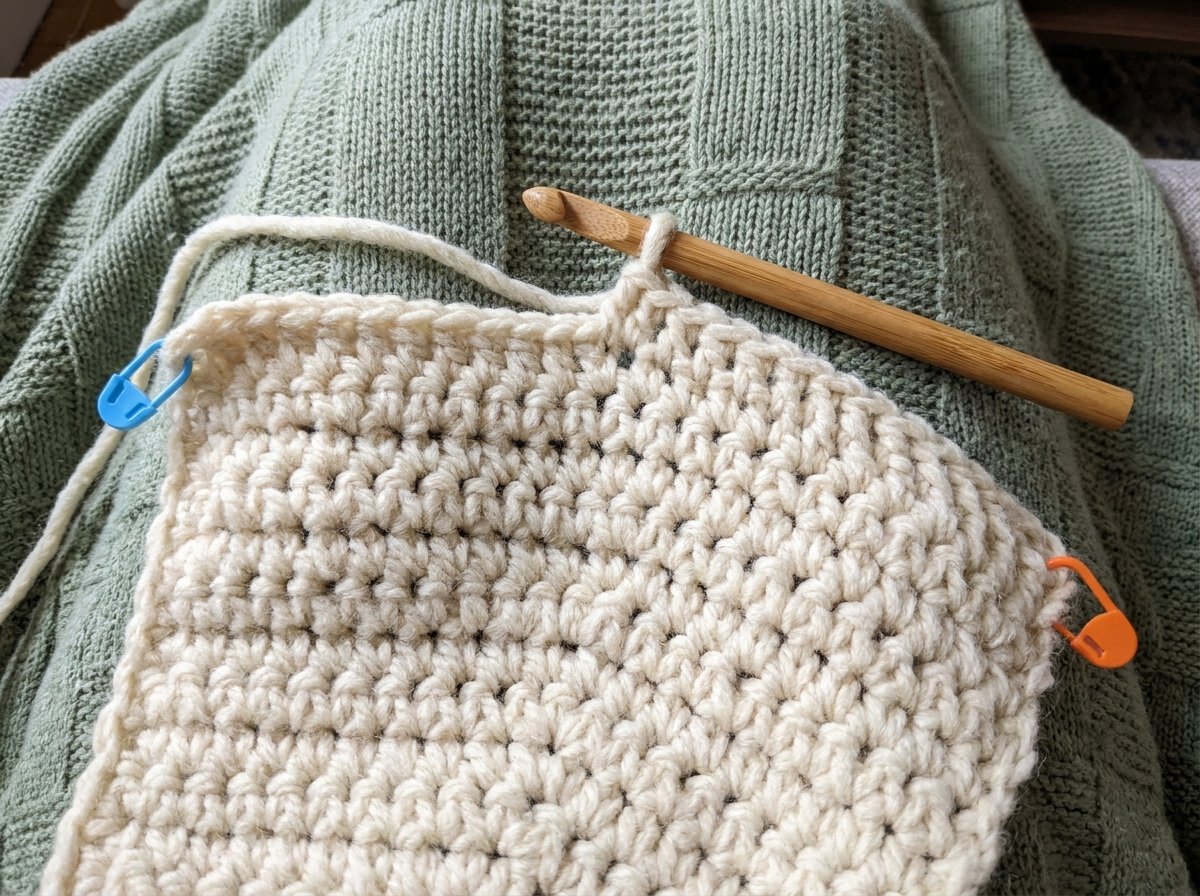
Row 1: Hdc in the 3rd ch from the hook and in each ch across. Turn. (90 hdc; the 2 skipped chains do not count as a stitch.)
Place a stitch marker in the first and last hdc of the row. Count your stitches now, while it’s easy to fix.
Step 4: Row 2 and the repeat
Row 2: Ch 2 (does not count as a stitch). Hdc in the first st and in each st across. Turn. (90 hdc)
Rows 3–88: Repeat Row 2 until the blanket measures about 50 inches long, or the length you want.
That’s the whole pattern. A few habits make it look much neater:
- Move your markers up every row. The very first stitch (right next to the ch 2) and the last stitch are the ones beginners skip. Markers stop that.
- Count every row for the first 10 rows, then every 5 rows. If the number changes, look at the edges first.
- Measure on a flat surface without stretching. Hanging fabric stretches lengthwise and lies to you.
- Stop at the end of a row when you put it down, and pull a big loop or add a marker in the live loop so nothing unravels.
If your edges start wobbling or the fabric bends into a curve, check out why crochet curls and how to fix the edge. It’s almost always a tension or stitch-count issue that’s easy to correct.
How to Join New Yarn and Change Colors
A lap throw will use several skeins, so you’ll join new yarn a few times. The cleanest place to do it is at the end of a row:
- Work the last hdc of the row until you have 3 loops on your hook.
- Drop the old yarn, pick up the new yarn, and pull it through all 3 loops.
- Leave both tails about 6 inches long, then ch 2 and continue with the new yarn.
The exact same method works for stripes. A classic, easy option: work 8 rows in color A, 8 rows in color B, and repeat. For a soft, Pinterest-style look, try cream, oatmeal and sage, or go festive with cranberry and cream for a Christmas throw.
Avoid knotting yarn ends together in the middle of a row. Knots can work loose in the wash and leave a hard bump in the fabric.
Finishing: Border, Ends and Blocking
Add a simple single crochet border
A border hides the slightly uneven row ends and makes your blanket look finished. Here’s the easiest one:
Round 1: Do not turn after the last row. Ch 1, then work sc evenly around the whole blanket: 1 sc in each stitch along the top and bottom, about 3 sc for every 2 rows along the sides, and 3 sc in each corner stitch. Sl st to the first sc to join.
Round 2 (optional): Ch 1, sc in each sc around, working 3 sc in the center sc of each corner. Join and fasten off.
If the sides ripple, you added too many stitches; if they pull in, add a few more. For crab stitch and other pretty edgings, see our easy crochet blanket borders tutorial.
Weave in your ends securely
Thread each tail onto your tapestry needle and weave it through the stitches in at least three directions (for example, left, then right, then up). Changing direction locks the end in place so it won’t pop out after washing. Trim close but not flush.
Block it (yes, even a blanket)
Acrylic blankets look dramatically softer and flatter after a light steam block. Pin the blanket to a large surface or foam mats, hover a steamer or iron above it (never press down on acrylic), and let it cool and dry completely before unpinning. Our blocking guide covers wet, spray and steam methods for every fiber.
How to Crochet a Blanket Faster
Making this as a holiday gift and watching the calendar? A few honest ways to speed up:
- Go chunkier. Super bulky (#6) yarn with a 10–12 mm hook cuts the number of rows dramatically.
- Use a taller stitch. Double crochet grows faster than hdc, though the fabric is airier.
- Make it smaller. A 30 × 40 in lap blanket is still a generous, very usable gift.
- Batch your time. Twenty minutes a night adds up faster than one long weekend session that makes your hands sore.
For realistic time estimates by size and stitch, read how long it takes to crochet a blanket.
Common Beginner Blanket Mistakes (and How to Fix Them)
- The blanket gets narrower (or wider) as you go. You’re skipping the first or last stitch, or adding one. Use stitch markers and count. If you’re only a stitch off, you can quietly hdc2tog or add a stitch at the end of the next row, but more than that is worth unraveling.
- The bottom edge is tight and puckered. The foundation chain was too tight. Next time, chain with a bigger hook. On this blanket, a border with an extra stitch here and there can relax it a bit.
- The ch 2 is counted as a stitch by accident. In this pattern it never counts. Always work your first hdc into the very first stitch of the row.
- Tension changes from day to day. Totally normal, especially when you’re tired or stressed. Measure your gauge every few sessions and relax your grip.
- Running out of yarn from the same dye lot. Buy all your yarn at once and check that the dye lot numbers on the labels match.
- Skipping the border. The border is what makes a homemade blanket look store-quality. It’s worth the extra hour.
Turning Your First Blanket Into a Gift
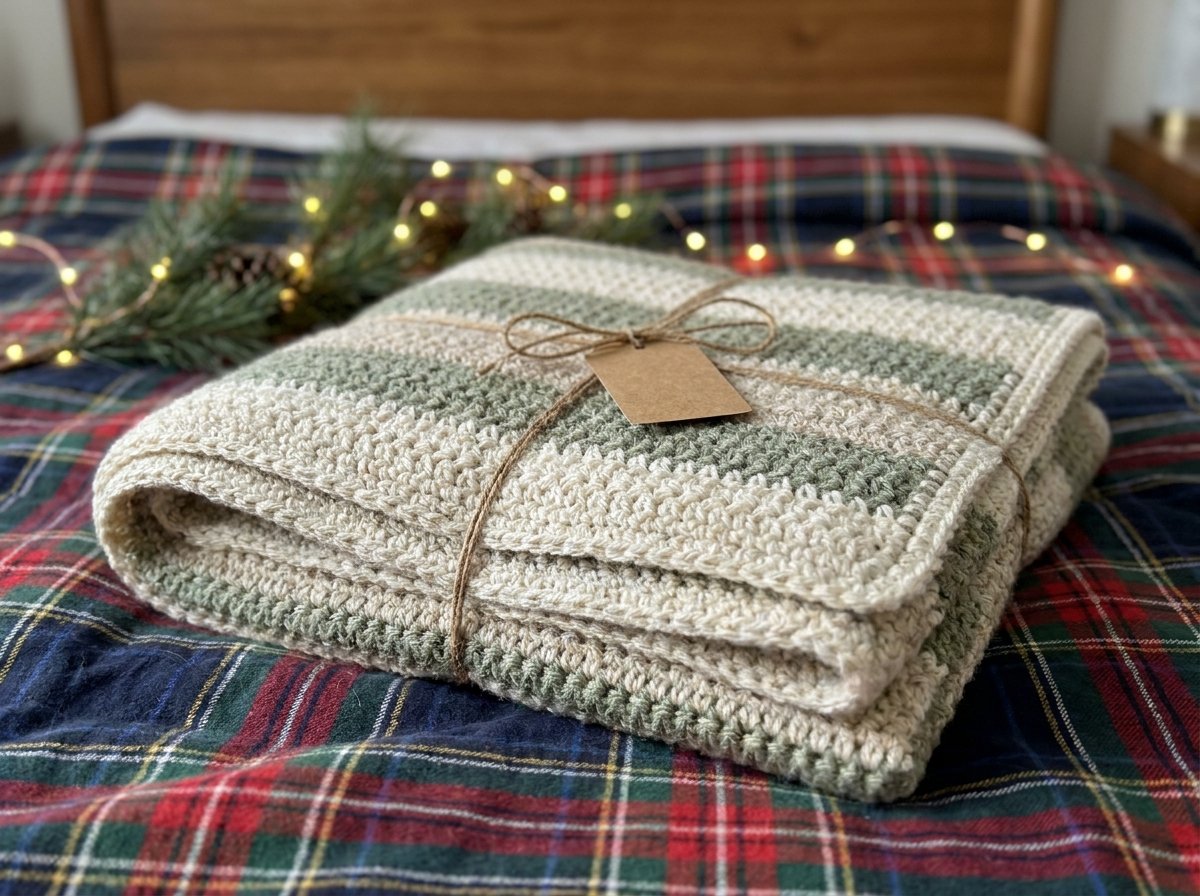
A handmade blanket is one of the most treasured gifts you can give, and late fall is the perfect time to start one. Fold it in thirds, tie it with twine or a fabric ribbon, and tuck in a small tag with the care instructions from the yarn label (most acrylics are machine wash cold, tumble dry low). If you’d rather work up a few smaller gifts alongside it, our quick crochet gifts are each done in an evening.
Once you’ve finished your first blanket, you might want something with a little more texture or a fun motif. You’ll find ready-to-print crochet patterns in the Yarvella Crochet pattern shop, and if you’d like to try a classic next, our granny square blanket guide shows how to plan and join squares.
FAQ: How to Crochet a Blanket
What is the easiest crochet stitch for a blanket?
Single crochet is the simplest stitch, but half double crochet is usually the best for a first blanket. It’s almost as easy, grows faster, and makes a warm, solid fabric that hides small tension changes.
Are crochet blankets easy for beginners?
Yes. A blanket worked in rows of one basic stitch has no shaping or assembly, so it’s very beginner-friendly. The main challenge is time, which is why bulky yarn and a simple stitch are recommended.
How many skeins of yarn do I need to crochet a throw blanket?
It depends on the skein size, not just the count. A bulky lap throw (about 40 × 50 in) in half double crochet needs roughly 1,100 to 1,300 yards. Divide that total by the yardage on your yarn label and round up, plus one extra skein.
How long does it take a beginner to crochet a blanket?
A chunky lap blanket typically takes a beginner around 15 to 25 hours of crocheting. Thinner yarn, bigger sizes, or textured stitches can push that well past 40 hours.
What size hook should I use for a crochet blanket?
Use the size recommended on your yarn label as a starting point. For bulky (#5) yarn that’s often around 8 mm (L-11); for worsted (#4) it’s usually 5 to 5.5 mm. Go up a half size if the fabric feels stiff.
What’s the difference between an afghan and a blanket?
In crochet, the words are mostly used interchangeably. “Afghan” traditionally refers to a crocheted or knitted throw, often made of colorful squares or patterned rows, while “blanket” is the general term for any size.
How do you crochet a blanket fast?
Use super bulky yarn with a large hook, choose a tall stitch like double crochet, and keep the size modest. A 30 × 40 in super bulky blanket can be finished in a few evenings.
Conclusion
Learning how to crochet a blanket really comes down to one stitch, a good chunky yarn, and a little patience. Chain loosely, mark your edges, count your rows, and finish with a simple border. By the time you weave in the last end, you’ll have a cozy throw for the couch (or a gift someone will keep for years), and your stitches will be smoother than they’ve ever been. Grab your hook, pour something warm, and start your foundation chain tonight.
Keep making
How to Crochet a Mug Cozy: Easy Free Pattern for Beginners (+ 3 Christmas Variations)
Learn how to crochet a mug cozy with a button in under an hour: measure any mug, pick the best yarn, follow a…
Read the guide
Corner to Corner Crochet (C2C) for Beginners: Step-by-Step Guide + Free Blanket Pattern
Learn corner to corner (C2C) crochet step by step: increase, decrease, rectangles, color changes, yarn amounts and a free diagonal stripe blanket pattern.
Read the guide