
How to Crochet Coasters for Beginners: Easy Free Pattern (Round + Square)
Learn how to crochet coasters with just two basic stitches and one ball of cotton yarn. Free round and square patterns, flat-circle math, fixes and gift ideas.
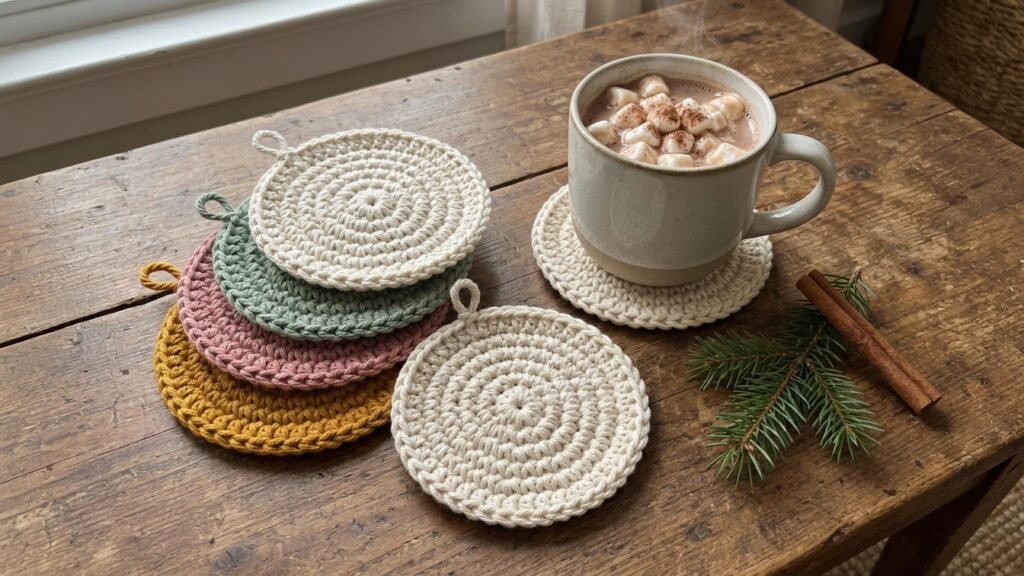
Crochet coasters are the project I hand to every new crocheter who asks, “What should I make first?” They are small enough to finish in one sitting, forgiving enough to hide a few wobbly stitches, and useful the moment you fasten off. Make a set of four and you have a handmade gift that actually gets used every single day, which is exactly why they fly off the hook this time of year.
In this guide you will learn how to crochet a round coaster that lies flat, plus a square version and a few festive variations. You only need two stitches, one ball of cotton yarn, and about an evening.
Quick answer: To crochet a coaster, use worsted weight (#4) cotton yarn and a 5 mm (H-8) hook. Start with 8 half double crochet (hdc) in a ring, then add 8 increases every round, spacing them evenly, for 5 rounds. Finish with a round of single crochet (sc). Each coaster is about 4 to 4.5 inches across, uses roughly 20 to 30 yards of yarn, and takes 20 to 40 minutes.
In this guide
- Why coasters are the perfect beginner project
- Materials: best yarn and hook for coasters
- Stitches and abbreviations you need
- Free pattern: easy round crochet coaster
- Variation: square crochet coaster
- Festive and gift variations
- How to keep crochet coasters flat
- Common mistakes and how to fix them
- Finishing, washing and gifting
- FAQ
Why Crochet Coasters Are the Perfect Beginner Project
A coaster teaches you almost every core skill in miniature. You practice holding tension, counting stitches, working in the round, placing increases, joining rounds and weaving in ends, all in a piece that fits in your palm. If something goes wrong, you rip back two rounds instead of two hours.
They are also genuinely practical. Cotton coasters protect wood tables from water rings, soak up drips from iced drinks, and sit under hot mugs without melting the way plastic ones can. That combination of “learn a lot” and “use it right away” keeps beginners motivated.
If you have never held a hook before, start with our step-by-step first crochet lesson, then come back here. You will be ready for this pattern after one practice swatch.
Project snapshot
- Skill level: Beginner
- Finished size: About 4 to 4.5 in (10 to 11.5 cm) across
- Time: 20 to 40 minutes per coaster for a beginner
- Yarn: Worsted weight (#4) 100% cotton, roughly 20 to 30 yards per coaster
- Hook: US H-8 (5 mm)
- Terms: US crochet terms
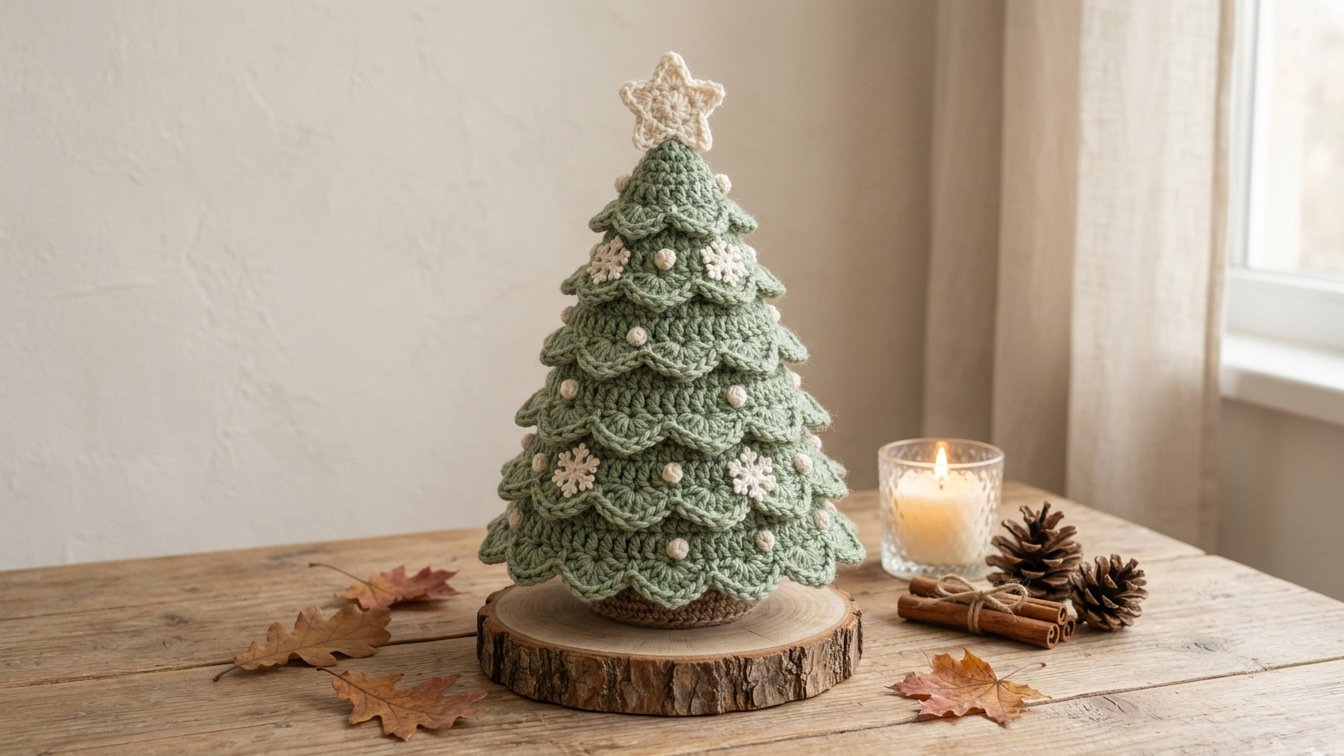
Materials: The Best Yarn and Hook for Crochet Coasters
What is the best yarn for coasters?
100% cotton is the best yarn for crochet coasters. Cotton absorbs moisture instead of letting it bead up, handles heat from coffee mugs, and survives the washing machine. It also gives crisp stitch definition, so your rounds look neat even when your tension is still settling.
Worsted weight kitchen cotton (the same kind used for dishcloths) is ideal. It is inexpensive, comes in lots of colors, and one standard ball usually makes a full set of four coasters. If you liked making our simple cotton dishcloth, you can use the leftover yarn right here.
Yarns to avoid
- Acrylic: It works, but it repels water rather than absorbing it and can deform under a very hot mug.
- Wool: It may felt in the wash and is not great with condensation.
- Chunky or fuzzy yarn: A coaster needs a flat, stable surface. Thick or textured yarn makes mugs wobble.
- Very thin cotton: Thread-weight cotton makes lovely coasters, but it is slow and fiddly for a first project.
Full supply list
- One ball of worsted weight cotton yarn in a main color (plus small amounts of a second color if you want stripes)
- US H-8 (5 mm) crochet hook
- Stitch marker or a scrap of contrasting yarn
- Scissors
- Tapestry (yarn) needle for weaving in ends
Tip: if your stitches look loose and holey with a 5 mm hook, drop to a G-6 (4 mm). Coasters should feel dense, not lacy.
Stitches and Abbreviations You Need
This pattern uses only basic stitches. If any of these are new, practice them on a small swatch first.
- ch = chain
- sl st = slip stitch
- sc = single crochet (see our single crochet guide)
- hdc = half double crochet (see our half double crochet tutorial)
- inc = increase: work 2 stitches into the same stitch
- st(s) = stitch(es)
Need a refresher on how patterns are written? Keep our crochet abbreviations cheat sheet open in another tab.
Why half double crochet?
Half double crochet is the sweet spot for coasters. It is taller than single crochet, so you finish faster, but still dense enough that liquid does not run straight through. It also creates a soft, slightly textured surface that looks great in solid colors.
Free Pattern: Easy Round Crochet Coaster
Pattern notes before you start:
- This coaster is worked in joined rounds with the right side facing you the whole time.
- The ch 2 at the start of each round does not count as a stitch.
- Stitch counts are in parentheses at the end of each round. Count every round; it is the single best habit you can build.
- Place a stitch marker in the first stitch of each round so you always know where to join.
Step 1: Make the center ring
Chain 4 and join with a sl st to the first chain to form a ring. (If you already know the magic ring, use it instead; it closes the center hole completely.)
Step 2: Work the rounds
Round 1: Ch 2. Work 8 hdc into the center of the ring. Join with a sl st to the first hdc. (8 sts)
Round 2: Ch 2. 2 hdc in each st around. Join. (16 sts)
Round 3: Ch 2. *1 hdc in the next st, 2 hdc in the next st;* repeat from * around. Join. (24 sts)
Round 4: Ch 2. *1 hdc in each of the next 2 sts, 2 hdc in the next st;* repeat from * around. Join. (32 sts)
Round 5: Ch 2. *1 hdc in each of the next 3 sts, 2 hdc in the next st;* repeat from * around. Join. (40 sts)
Step 3: Add the border
Round 6 (border): Ch 1. 1 sc in each st around. Join with a sl st to the first sc. (40 sts)
Fasten off, leaving a 6 inch tail. Weave in all ends.
That is it. You just made a coaster. Measure it: it should be about 4 to 4.5 inches across. Most mugs and glasses have a base between 2.5 and 3.5 inches, so this size leaves a comfortable margin.
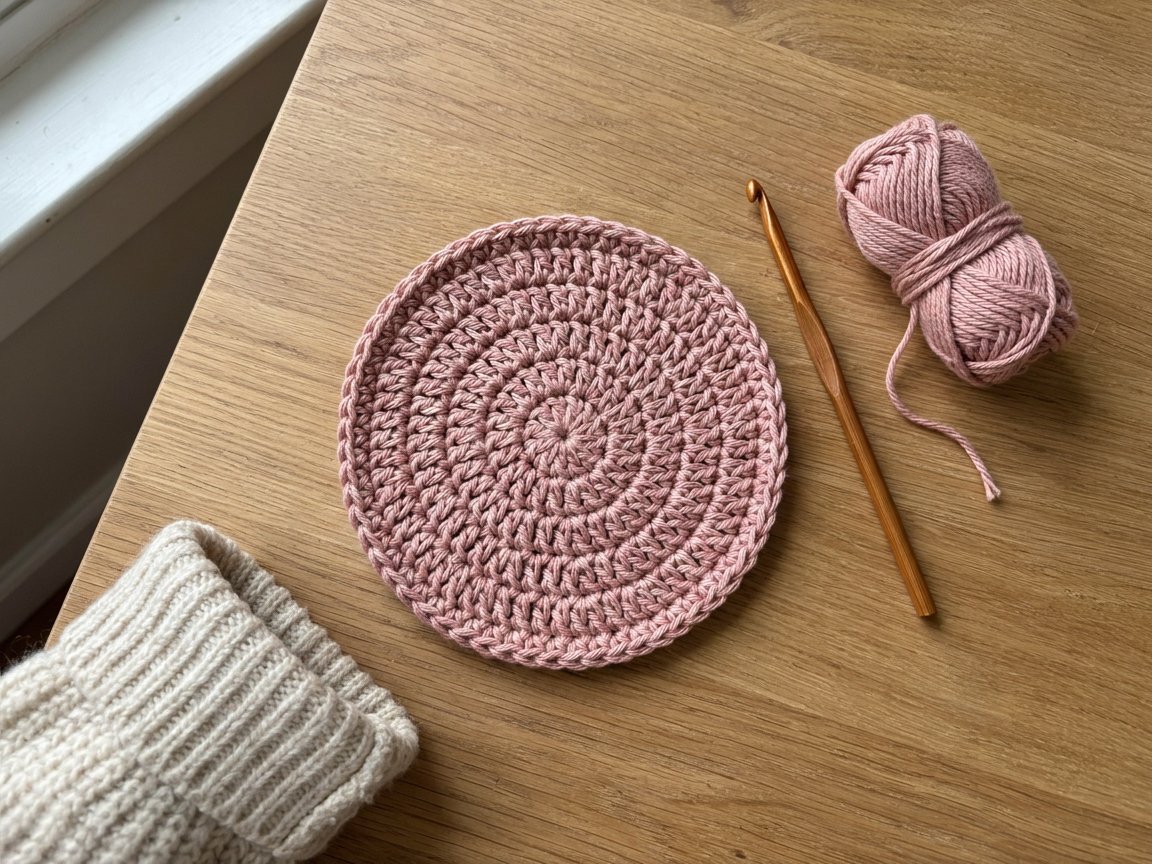
The simple math behind a flat circle
Once you see the pattern, you can make coasters any size. In hdc, you start with 8 stitches and add 8 stitches every round. Each round, you work one more plain stitch between increases:
- Round 1: 8 sts
- Round 2: inc in every st (16)
- Round 3: 1 st, inc (24)
- Round 4: 2 sts, inc (32)
- Round 5: 3 sts, inc (40)
- Round 6: 4 sts, inc (48), and so on
Want a bigger trivet for a teapot? Keep going to round 8 or 9. Want a tiny coaster for espresso cups? Stop after round 4 and add the border.
Working in single crochet instead? Start with 6 sc and add 6 every round. Your coaster will be denser and a little smaller per round, so you will need a couple of extra rounds.
Variation: Square Crochet Coaster (Worked in Rows)
If working in the round still feels confusing, a square coaster in rows is even easier. It uses only single crochet.
Foundation: Ch 15.
Row 1: Sc in the 2nd ch from the hook and in each ch across. Turn. (14 sts)
Rows 2 onward: Ch 1 (does not count as a st). Sc in each st across. Turn. (14 sts)
Repeat until the piece is as tall as it is wide, usually 14 to 16 rows. Fold one corner diagonally to check: when the edges line up, you have a square.
Border: Ch 1, then sc evenly around all four sides, working 3 sc in each corner so it stays flat. Join and fasten off.
Count your stitches at the end of every row. Losing or gaining one stitch at the edges is the most common reason squares turn into trapezoids.
Festive and Gift Variations
The basic round coaster is a blank canvas. Here are easy ways to dress it up for holiday gifting:
Striped holiday coasters
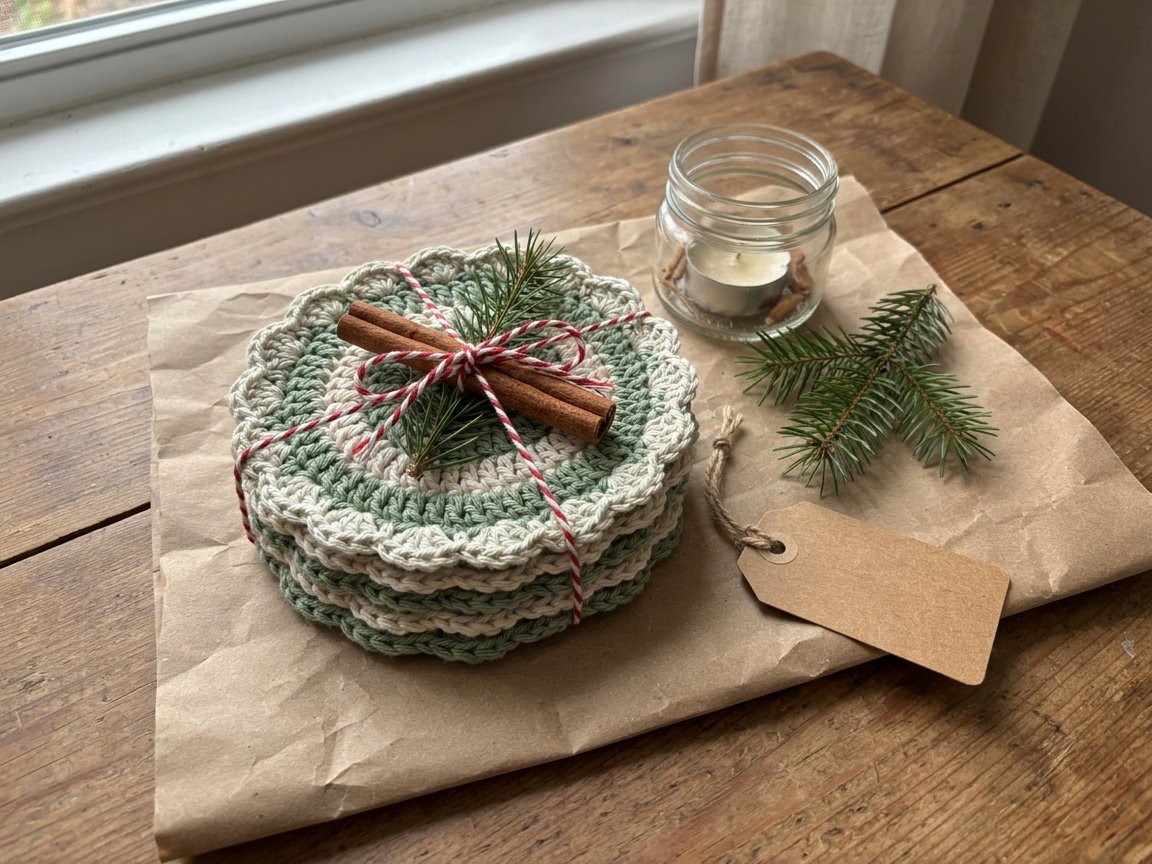
Change colors at the start of any round. Red, green and cream look classic for Christmas; cranberry, oatmeal and forest green feel more modern farmhouse. To change color, work the final sl st of the round with the new color, then carry on. Our guide on fixing curling crochet also covers how tension changes when you switch yarns.
Mix-and-match set
Make four coasters using the same colors in a different order. Each one looks unique, but the set still reads as a matched gift.
Reverse single crochet edge
For a rope-like border, work Round 6 in reverse single crochet (crab stitch), moving left to right instead of right to left. It is a lovely, sturdy edge for coasters that will see daily use.
Mug cozy bundle
Pair a set of coasters with a favorite mug, a packet of cocoa and a mug cozy. It is one of our favorite quick crochet gifts you can make in one evening.
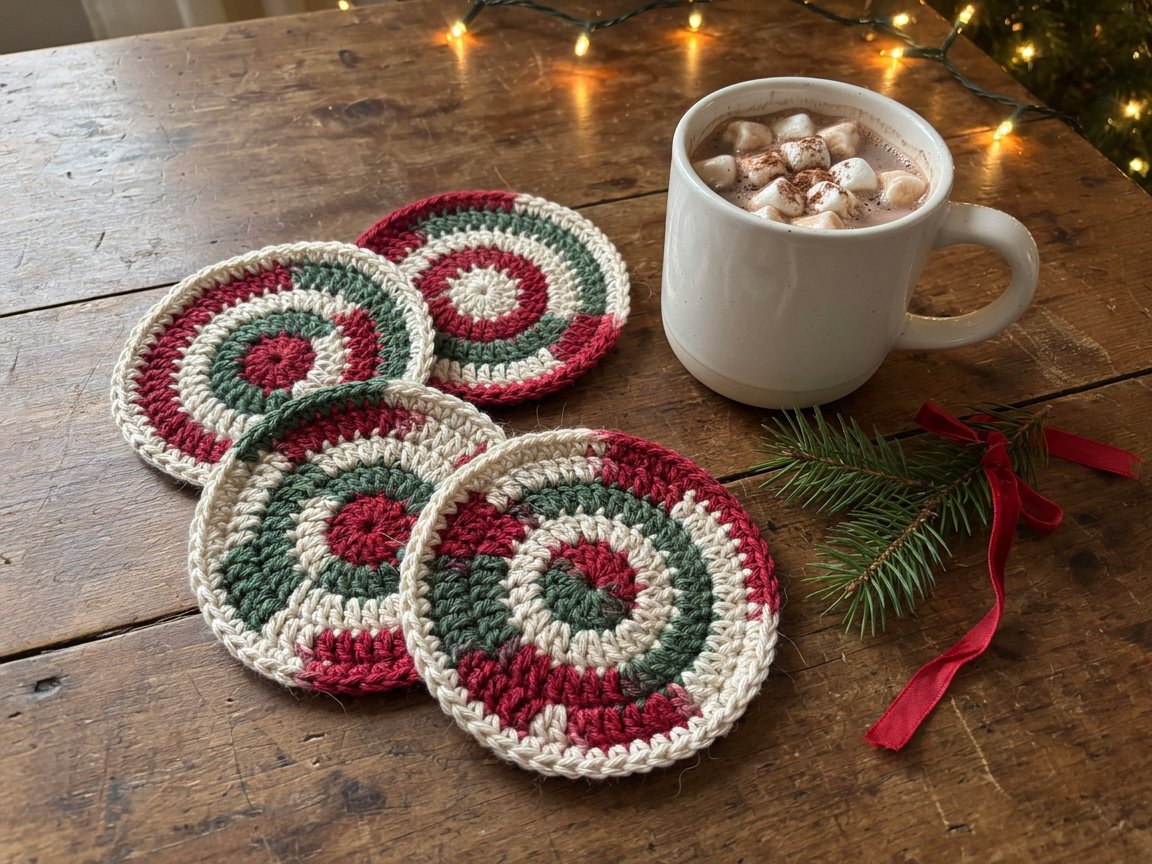
How to Keep Crochet Coasters Flat
A coaster that cups or ruffles will tip mugs, so flatness matters more here than in almost any other project. Here is how to diagnose the shape:
- Coaster cups like a bowl: You do not have enough stitches. You probably skipped an increase or worked into the ch 2 incorrectly. Count each round and compare it to the pattern.
- Coaster ruffles like a wave: You have too many stitches. Often this comes from accidentally working into the joining slip stitch, which adds an extra stitch each round.
- Coaster is flat but looks like a hexagon: Stacked increases create corners. Stagger them by moving the increase position slightly each round (for example, work “inc, 3 hdc” on Round 5 instead of “3 hdc, inc”).
Tight tension can also cause cupping even when your counts are right. If that happens, go up one hook size for the last two rounds.
Finally, blocking fixes small wobbles beautifully. Pin your damp coasters flat and let them dry. Our blocking guide walks through wet and steam blocking for cotton.
Common Beginner Mistakes (and Quick Fixes)
- Counting the ch 2 as a stitch. In this pattern it does not count. If you work into it, your coaster grows extra stitches and ruffles.
- Losing the first stitch. The first hdc of a round hides right next to the join. A stitch marker solves this instantly.
- Visible joining seam. Joined rounds leave a faint diagonal line. That is normal. You can make it less obvious by joining into the top of the first stitch, not the chain.
- Big hole in the center. A chained ring always leaves a small hole. Pull the starting tail snug before weaving it in, or switch to a magic ring.
- Ends popping out after washing. Weave each tail in three directions for about 2 inches total. Cotton is slippery, so short weaves tend to work loose.
- Uneven sizes across the set. Tension changes as you relax. Measure your first coaster and compare each new one before the border round.
Finishing, Washing and Gifting Your Coasters
Weaving in ends
Use a tapestry needle to run the tail through the back of the stitches, change direction, and go back the way you came. Trim close to the fabric. A coaster gets handled constantly, so a secure finish is what makes it look store-bought.
Can you wash crochet coasters?
Yes. Cotton coasters can usually go in the washing machine on a gentle cycle. Check the yarn label: many kitchen cottons can be machine dried, but some shrink slightly, so air drying flat is the safest choice for keeping them perfectly round.
Gift-wrapping ideas
- Stack four coasters and tie them with baker’s twine and a sprig of pine or a cinnamon stick.
- Tuck the set into a mason jar with a cocoa packet.
- Add a handwritten care tag: “Cotton, wash gentle, lay flat to dry.”
Making coasters to sell at a holiday market? They are consistently popular, inexpensive to produce, and easy to display. See our list of crochet items that sell at craft fairs for pricing and bundle ideas. And if you are ready for your next project, browse our printable patterns at the Yarvella Crochet pattern shop.
Crochet Coasters FAQ
How big should a crochet coaster be?
Most coasters are 4 to 4.5 inches across. That fits standard mugs and drinking glasses with a little room around the base. Go up to 5 inches for large mugs or stemless wine glasses.
How much yarn do you need to crochet a coaster?
A 4 inch coaster in worsted cotton uses roughly 20 to 30 yards, depending on your tension and stitch. A standard ball of kitchen cotton is usually enough for a set of four.
What is the best yarn for crochet coasters?
100% cotton in worsted weight is best. It absorbs condensation, tolerates hot mugs and is machine washable. Acrylic works but does not absorb moisture well.
What stitch is best for crochet coasters?
Single crochet and half double crochet both work well because they make a dense fabric. Half double crochet is faster; single crochet is thicker and slightly more absorbent.
How long does it take to crochet a coaster?
Most beginners finish one coaster in 20 to 40 minutes. Once you have the rhythm, a full set of four is an easy one-evening project.
Why is my crochet coaster not lying flat?
If it cups, you have too few stitches; if it ruffles, you have too many. Count each round against the pattern, avoid working into the joining slip stitch, and block the finished coaster.
Do crochet coasters actually work?
Yes, as long as you use cotton and keep the fabric dense. Cotton coasters soak up drips and condensation and protect wood surfaces from water rings and heat.
Ready to Make Your First Set?
Crochet coasters are proof that a small project can teach big skills. In one evening you will practice working in the round, placing increases, counting, joining and finishing, and you will end up with something you use every day or wrap up as a gift. Start with the round pattern in one color, then play with stripes and borders once you feel confident.
Make a set, snap a photo of it under your morning coffee, and tag us at @yarvella.crochet. We would love to see your stitches.
Keep making
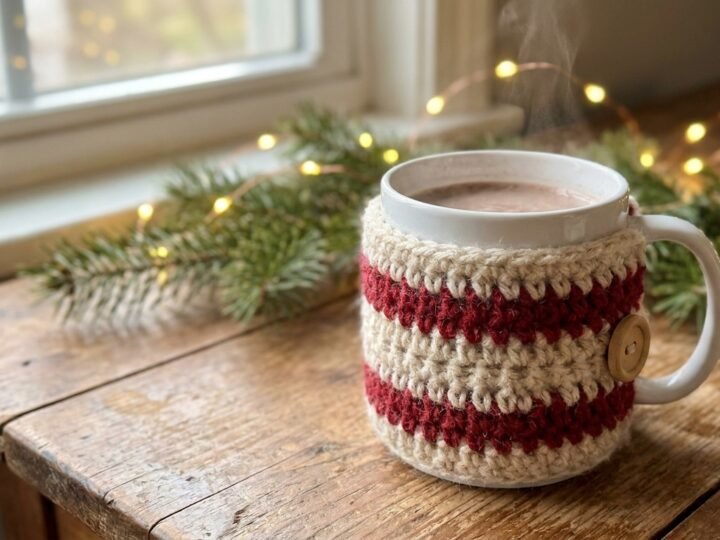
How to Crochet a Mug Cozy: Easy Free Pattern for Beginners (+ 3 Christmas Variations)
Learn how to crochet a mug cozy with a button in under an hour: measure any mug, pick the best yarn, follow a…
Read the guide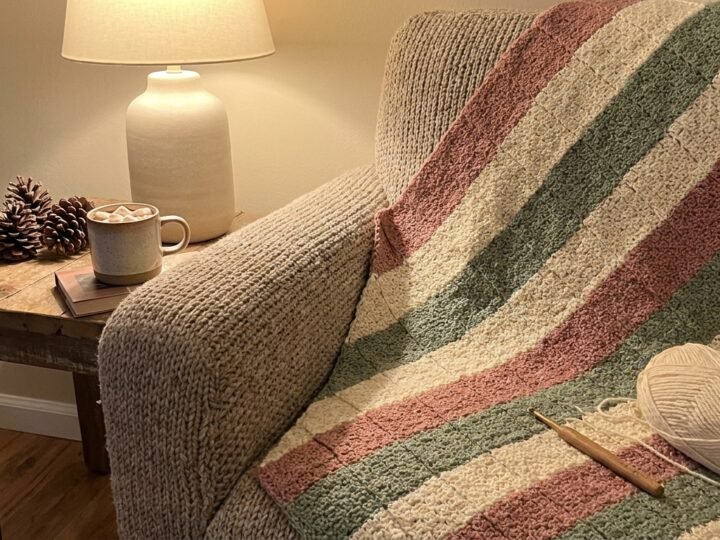
Corner to Corner Crochet (C2C) for Beginners: Step-by-Step Guide + Free Blanket Pattern
Learn corner to corner (C2C) crochet step by step: increase, decrease, rectangles, color changes, yarn amounts and a free diagonal stripe blanket pattern.
Read the guide